
A professor from a Dubai university has emphasised that the key to preserving the Arabic language lies in implementing a ‘family language policy’ (FLP).
Dr Reem Razem, an assistant professor from the Rochester Institute of Technology (RIT) in Dubai, highlighted that a bottom-up approach, with small changes at the family and community level can spark a significant shift in societal communication, ultimately helping to protect and promote Arabic.
The Arab expert explained that parents play a crucial role in driving informal societal change. The use of mother tongues, she said, forms a vital connection between children and their parents, linking generations to both their past and future.
This idea was sparked by her observations of her own children during the Covid-19 lockdown, which led her to embark on a study exploring the prevalence of English speaking among the second generation in Arab families.
As a Jordanian expat with three bilingual sons, Dr Razem noticed a language shift during the lockdown. “When we were confined to our homes, I began to wonder why my boys spoke in English to each other and sometimes responded in English when I addressed them in Arabic,” she said.
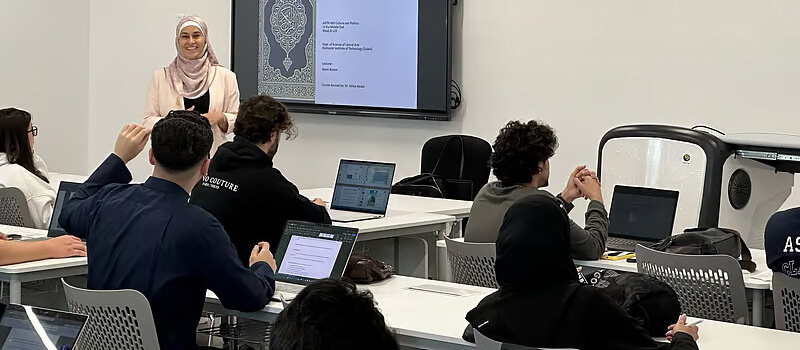
This curiosity led her to undertake an autoethnography research project, where she filmed her sons’ conversations. The results revealed that 30-40 per cent of their speech was in English. “(But) Conversations between myself and my husband, and when addressing our children, was 90-95 per cent Arabic,” she shared.
She identified key factors influencing this language shift. “When discussing topics related to online learning or technology, my children would often switch to English,” she explained. “Similarly, anything related to entertainment, like music, movies, or series would prompt them to use English. This means that they didn’t have the Arabic vocabulary for those subjects.”
Building on her autoethnography (qualitative research method) study, Dr Razem expanded her research to include the wider Jordanian expat community in the UAE. She discovered a common theme across social media groups for Jordanian mothers in the UAE — many expressed frustration over their children’s loss of Arabic.
“I noticed so many posts delving into language shift, parents being unhappy and frustrated with Arabic language loss, and their children not understanding or valuing Arabic. The majority of the posts on the subject were seeking advice on how to instil the love of Arabic, revitalise and preserve the Arabic language in their children’s upbringing, and encourage them to use Arabic at home and in their communities,” she shared.
Dr Razem found that there were a number of issues impacting Arabic literacy, including the shift to English as a medium of instruction in schools and universities, which meant English had become the language of communication and education. She also pointed to small, unconscious acts, such as selecting English over Arabic at an ATM, which were contributing to the decline in usage.
Discussing potential strategies to boost Arabic language use, she added that there is an intersectionality between the role of the parents at home and the role of the immediate community, and the crucial role of schooling.
“We need to make a conscious choice to preserve the language through a bottom-up approach. Family is a nucleus of social change and taking small steps to raise awareness and practice Arabic can help to create a larger-scale movement,” she said.
Dr Razem likened this to the Butterfly Effect, where small, deliberate actions can set off far-reaching consequences. “The decisions parents make daily, such as the language they choose to speak at home, the schools they select, and the day-to-day social and cultural practices they emphasise, carry the potential to reverse language shift and preserve Arabic as a cornerstone of identity and heritage,” she explained.
Meanwhile, educators in the country agree that family language policy plays a key role in preserving Arabic among second-generation expatriates in the UAE.
“Parents can promote the use of Arabic at home, encouraging daily reading and conversation, while communities can support cultural and educational activities that reinforce linguistic identity. Providing engaging educational and recreational environments in Arabic also helps to establish it among new generations,” Abhilasha Singh, Principal Shining Star International, Abu Dhabi said.
Experts pointed out children have a remarkable ability to acquire multiple languages effortlessly from an early age. “When they are encouraged to express themselves freely in both Arabic and English, they are not only equipped for a diverse social life but also develop an open-minded perspective, where differences are accepted as natural rather than as sources of conflict,” said Girish Hemnani, Life Coach and Energy Healer based in Dubai.
“This bilingual foundation erases cognitive dissonance, allowing children to navigate various cultures seamlessly. It fosters intellectual flexibility, improves problem-solving abilities, and enhances emotional intelligence — skills that are invaluable in today’s interconnected world,” Girish added.
© Khaleej Times








 Twitter